
Wang Jianlin Spoke at the Conference on the Development of China's Private Economy
Jan 12,2012
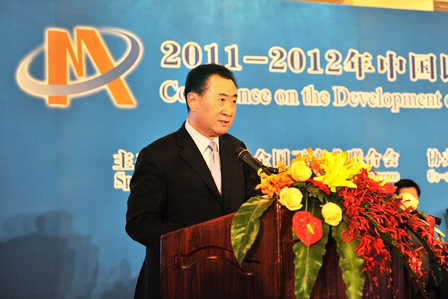
On 11th Jan 2012, China’s industry and commerce federations organized a “2011-2012 Conference on the Development of China's Private Economy” was held in Beijing. Wang Jianlin, Chairman of Wanda, attended the conference and gave a speech.
The theme of Chairman Wang’s speech was “Much to Accomplish in the Area of Developing the Cultural Industry by Private Companies", acknowledging Wanda's practical contribution to the growth of the cultural industry, and encouraging other private companies to do the same.
Chairman Wang first introduced the progress of Wanda's development of the cultural industry. Since the establishment of the Wanda Group in 2005, it started to invest in the cultural industry and ventured into four areas, which were big stage performances, movie screenings and productions, culture and entertainment chains, Chinese calligraphy and painting collections, with cumulative investments currently exceeding Rmb 10 billion, the largest investor in China's cultural industry, with over 10% ROI. Wanda’s cultural industry has received affirmation in various aspects.
The growth of Wanda’s cultural industries has mainly three special traits. The first trait is innovation. Wanda’s innovatively combined shopping, F&B, culture, and entertainment into one building, calling it a "Urban Complex". The marketing trends complement each other, especially where the huge crown sustains the cultural and entertainment industries, combining many elements to achieve excellent operational effectiveness. The second trait is chain store management, which is what Wanda specially focuses on. Unified brand, unified business canvassing, unified operations, unified IT management. The third trait is the establishment of new consumption hotspots. To increase domestic demand, there is a need to increase consumption in the cultural, entertainment, and fitness industries. The cultural industry has a lot of growth potential, but the key is in the availability of good business models and price stimulants.
Chairman Wang cited a few examples of Wanda’s contribution to the growth of the cultural industry. 1. Culture can be developed into a big industry. Since Wanda Cinema was established in 2005, its revenue grew 18.5X in a short span of six years. A few years later Wanda Cinema became a world class company in the industry. 2. Private companies can become the primary drivers of the cultural industry. The cultural industry refers to the creative industries, where the demand for innovation is high. In this aspect, State-owned Companies may fall short. Private companies have more flexible mechanisms, with strong innovative capability. If creative industries performs well, market opportunities can be grasped accurately, bringing in the big bucks. 3. Practical experience has proven that private companies have much to offer in growing the cultural industry. In the cultural industry, there was a very huge gap between private companies and State-owned Companies. However, due to opposing mechanisms, plus a rational business model to boot, private companies overtook State-owned Companies soon after, increasing the market share every year. 4. Current new opportunities due to the transition upgrade of private companies. The “12th Five-Year Plan” mentioned the must for a transition upgrade, where private companies can work towards growing the cultural industry and creative industry, turning them into transition upgrade opportunities.